Could Your Failed 3D Prints Become Food? Scientists Are Turning PLA Waste Into Protein

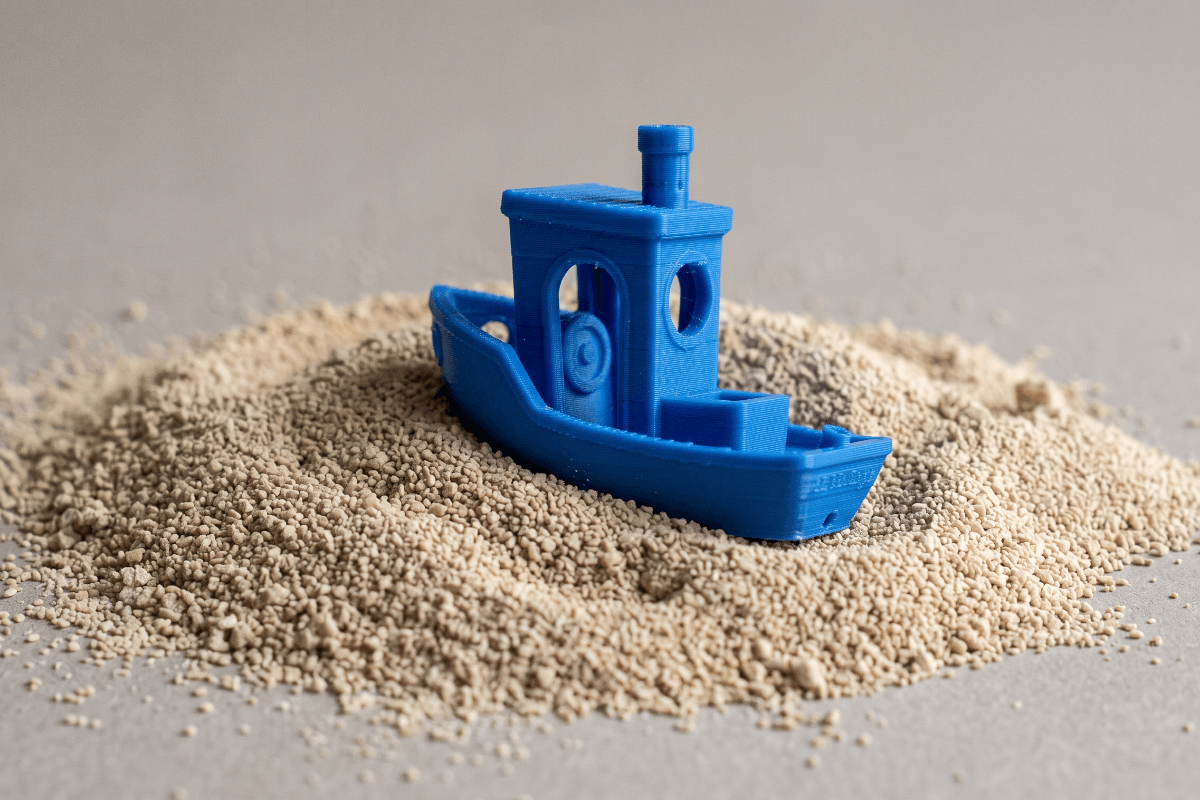
Even though printers have gotten much better in recent years.. every 3D printer eventually produces the same thing: a collection of failed prints.
A prototype that was off by a half a millimeter. Supports and purge material. The first layer you stopped five minutes in. An old classroom project that nobody needs anymore. Most of it eventually ends up in the trash!
But researchers are investigating a considerably stranger destination for waste PLA: protein.
A preliminary study by researchers L. Danier and Joshua M. Pearce explored whether polylactic acid (PLA) waste from 3D printing could be chemically broken down and used as a feedstock for growing microorganisms.
The early results suggest that it can.
And while we should get one thing out of the way immediately, no, you shouldn’t eat your Benchy, the research raises some fascinating questions about what the end of a 3D print’s life could look like in the future.
PLA Is More Than Just Plastic
PLA is one of the most common materials in desktop 3D printing, particularly in schools, libraries, makerspaces, and homes.
Its full name is polylactic acid, and unlike many conventional petroleum-based plastics, PLA is commonly produced from renewable plant-derived materials.
That doesn’t mean a PLA print magically disappears when you throw it away.
A failed print can still persist as waste, and anyone operating multiple 3D printers knows how quickly scraps, supports, purge material, test prints, and failed projects can accumulate.
Recycling PLA is possible, but it presents its own challenges. Plastic can be mechanically shredded and reprocessed, for example, but repeated heating and processing can affect its properties.
The new research asks a very different question:
Instead of turning old PLA into another piece of plastic, could we turn it into something biological?
From PLA to Yeast
This is where things get interesting.
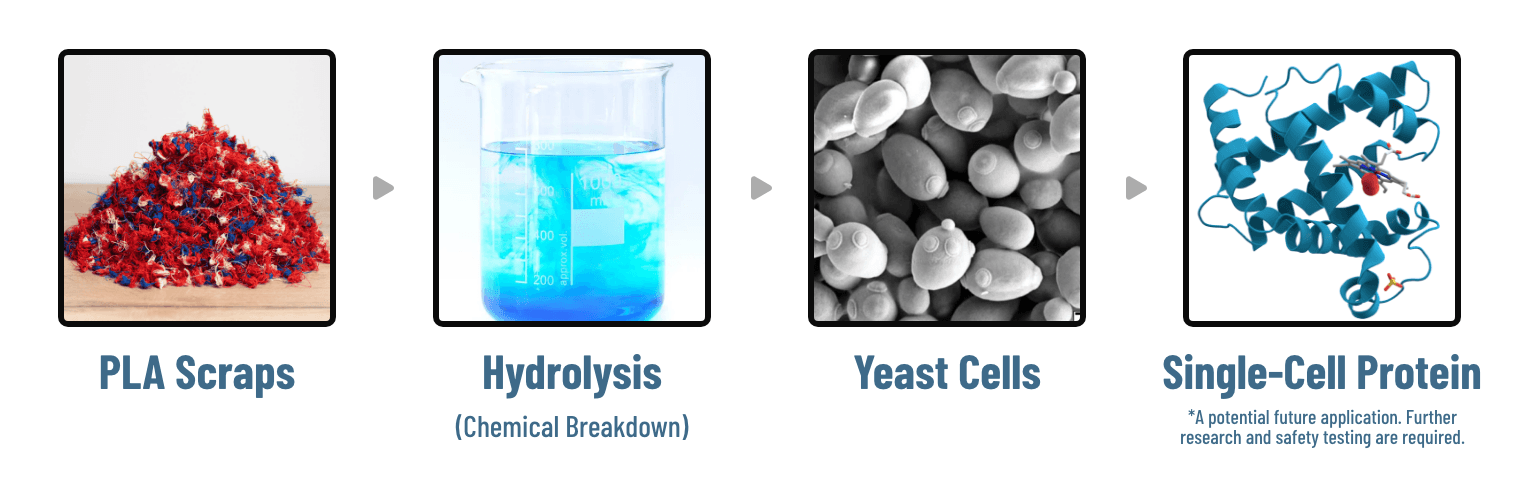
The researchers investigated chemically breaking down PLA through a process called hydrolysis. Rather than treating a failed print as one permanent plastic object, the process breaks its long polymer chains into much smaller chemical components.
Those components can potentially become a source of carbon for microorganisms.
In this preliminary investigation, the researchers tested whether hydrolyzed PLA waste could support the growth of yeast.
It did.
Under one of the experimental conditions, the researchers reported approximately an 8.5-fold increase in yeast biomass.
That’s important because yeast itself can serve as what researchers call single-cell protein: protein-rich microbial biomass that can potentially be produced for food, animal feed, or other applications.
The basic idea looks something like this:
Failed PLA print → chemical breakdown → microbial feedstock → yeast growth → protein-rich biomass
That’s a radically different vision of recycling.
Instead of simply asking how many times we can turn one plastic object into another, researchers are asking whether some of the carbon contained in that material can eventually be redirected into an entirely different biological system.
No, Don’t Eat Your Benchy
There is a very important distinction between an interesting laboratory result and something that’s ready for your dinner plate.
This research is preliminary.
The authors specifically note that additional work is needed to understand the chemistry, optimize the process, and determine whether biomass produced this way could safely be used for food.
There are also practical questions surrounding pigments, additives, contamination, different PLA formulations, and the other materials that inevitably find their way into real-world 3D printing waste streams.
So this isn’t a recipe for turning your failed prints into lunch.
What the experiment demonstrates is arguably more interesting anyway: waste PLA can potentially become a resource for another manufacturing process rather than simply reaching the end of its useful life.
The Bigger Question: What Should Happen to Failed 3D Prints?
3D printing has always challenged some of our assumptions about manufacturing.
Traditionally, making an object means designing it, manufacturing it somewhere, shipping it, storing it, and eventually delivering it to the person who needs it.
With digital manufacturing, the information and the physical object can be separated.
A student can find or create a model online, send it to a printer, and manufacture the physical object where it is actually needed.
But distributed manufacturing creates another challenge: distributed waste.
One school may only discard a small amount of PLA. Multiply that by dozens of printers, hundreds of classrooms, thousands of schools, libraries, universities, businesses, and millions of individual users, and those scraps start to matter.
There probably won’t be one solution.
Some waste may be mechanically recycled into new filament or pellets. Some objects can simply be reused. Better slicing, printer monitoring, and more reliable machines can prevent failed prints in the first place.
And perhaps, eventually, biological processes could recover value from material that would otherwise be discarded.
A Pretty Great STEM Question
For educators, the research is also a reminder that a 3D printer doesn’t have to belong exclusively to an engineering or computer science classroom.
Consider everything contained in this one experiment.
There’s chemistry in understanding polymers and hydrolysis.
There’s biology in growing yeast.
There’s engineering in developing a practical recycling process.
There’s environmental science in evaluating material waste and lifecycle impacts.
There’s math in measuring growth rates, concentrations, yields, and efficiency.
And there’s a much larger design question for students to consider:
When we manufacture something, should we also be designing what happens to it when we’re finished with it?
That’s a powerful question whether you’re designing a billion-dollar consumer product or a 20-gram PLA part in a middle-school makerspace.
3D Printing Is Still a Young Technology
It’s easy to forget how quickly additive manufacturing is evolving.
We’ve spent much of the last decade making 3D printers faster, cheaper, easier to use, and more reliable. Now we’re beginning to ask more mature questions about the entire lifecycle surrounding them.
How do we reduce failed prints?
How do we reuse material?
How do we recycle it locally?
Can waste become feedstock?
And, apparently, could microorganisms someday turn part of that waste into protein?
We don’t know yet where this particular research will lead.
But the idea that yesterday’s failed 3D print could become tomorrow’s raw material, perhaps for something completely unrelated to 3D printing, is exactly the kind of strange and exciting possibility that makes this technology worth following.
Bring 3D Printing Into Your Classroom
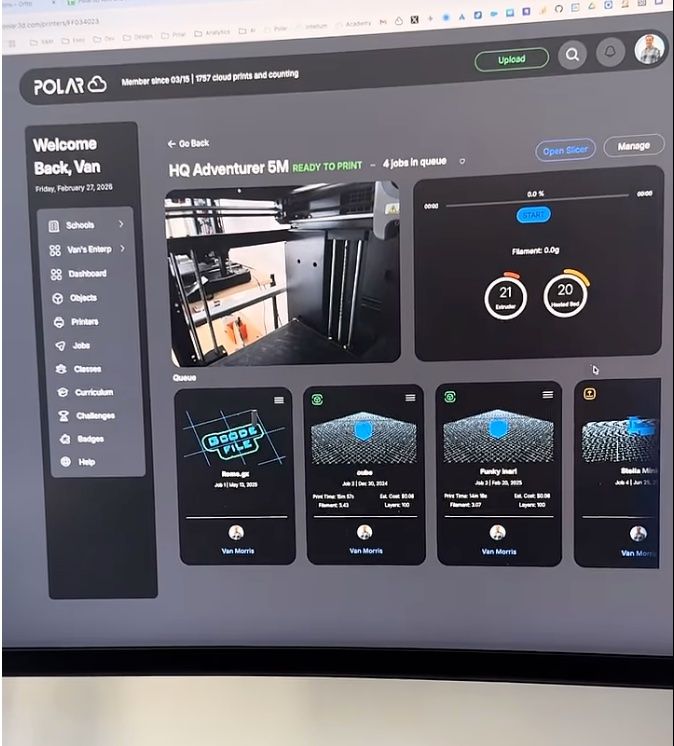
Polar Cloud helps schools manage 3D printing from the browser, giving students and educators an easier way to create, share, and manufacture projects without being tied to a single computer.
Teachers can manage printers and projects, students can work from Chromebooks and other devices, and schools can bring multiple printers and users together in one platform.
Explore Polar Cloud and start 3D printing with your classroom.
Sources
- L. Danier and Joshua M. Pearce, Preliminary Investigation of Upcycling Polylactic Acid 3-D Printing Waste to Candidate Single-Cell Protein Feedstock, available through Appropedia.
- Joshua M. Pearce, 3D Printing Waste Got You Down? Science Makes It Into Protein. Eat It?, Forbes, September 14, 2026.
Subscribe for updates
Get Polar Cloud news and help delivered straight to your inbox.
More from the blog