Watching DJI Engineers Change the Maker Hardware Landscape

There's a pattern forming, and once you see it you can't unsee it.
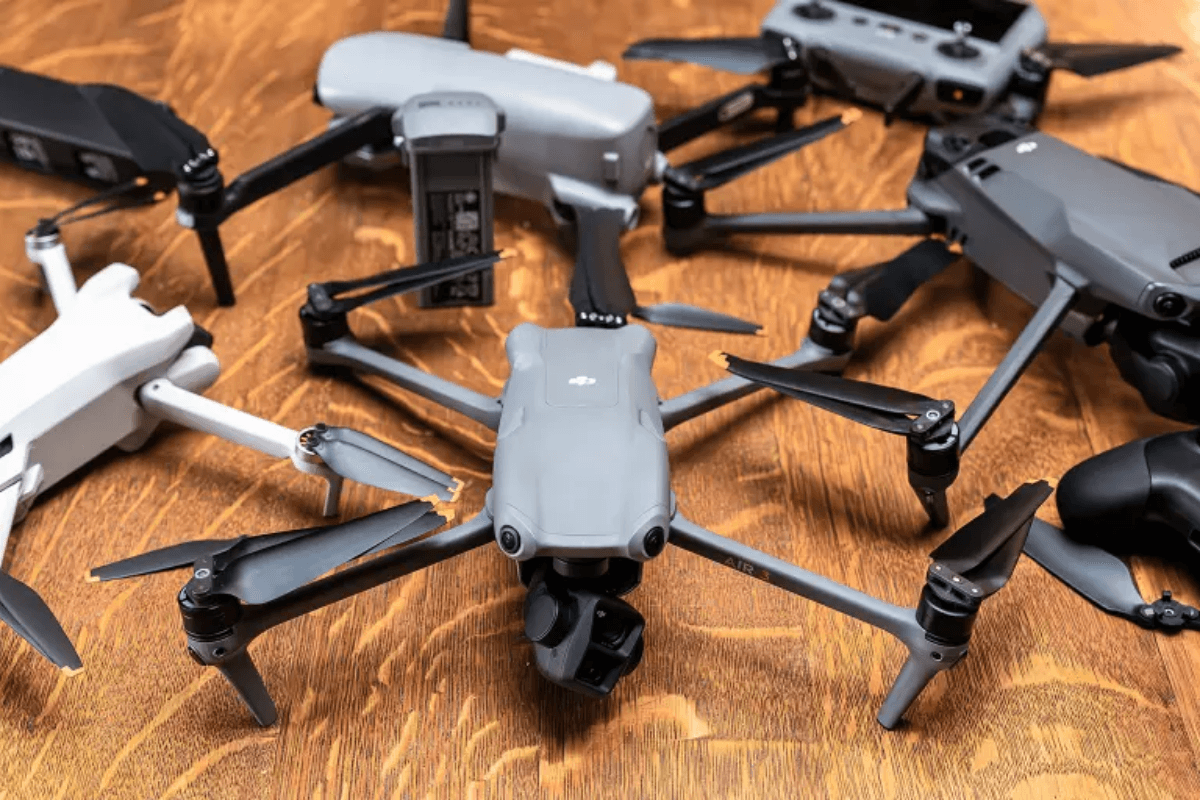
In 2020, five people walked out of DJI and decided to build a 3D printer. Not a better 3D printer — a product. Among them: the product manager behind the Mavic Pro and head of DJI's consumer drone division, the former head of DJI's Systems Engineering Department, and the product manager who shipped DJI's FPV goggles and digital transmission system. They rented an unremarkable office, hung no sign on the door, did no press, and spent 22 months burning through prototypes — V1 through V7 — before anyone outside the building knew they existed. Then in May 2022 they surfaced with the Bambu Lab X1 and a crowdfunding campaign that cleared 40 million RMB in a month.
You know how that story went. The rest of the desktop FDM market spent the next three years reacting.
I've been watching this space for about a decade, and what struck me about Bambu wasn't the hardware. Core XY wasn't new. Input shaping wasn't new. Automatic bed leveling wasn't new. Almost nothing in that machine was a first. What was new was that someone had assembled the whole thing with the assumption that the buyer's patience is a finite, expensive resource — and had the manufacturing muscle to actually ship it at volume.
That's a DJI instinct, and it's the thing worth paying attention to now, because two more teams out of that same building are aiming at adjacent corners of the maker bench.
What the DJI playbook actually is
I think DJI knows how to bring a product to market. They're good at packaging and firmware and making the entire unboxing feel like an experience, not an afterthought.
It doesn't end there. The unboxing is the visible tip of something more structural:
They treat the first hour as a product feature. Most maker hardware ships as a kit of parts with a PDF. DJI-lineage products ship assembled, calibrated, and with the software already knowing what machine it's talking to. The out-of-box experience isn't marketing polish — it's a deliberate decision about who the customer is. It says: you are not a hobbyist debugging our machine, you are a person with work to do.
Firmware is the product, not a driver. Motion control, sensing, and compensation are where the differentiation lives. A drone that holds position in wind is doing the same category of work as a printer compensating for resonance or a mill adapting feed rate. These teams are fluent in closed-loop control in a way that most of the maker hardware industry simply isn't, because most of the maker hardware industry grew out of open-source firmware forks rather than out of shipping millions of flight controllers.
Iterate privately, launch loudly. Seven prototype generations in stealth is not how the maker world traditionally operates. The maker world builds in public, ships v1 early, and lets the community find the failure modes. DJI alumni do the opposite — they absorb the iteration cost internally and arrive with something that already works. It's more expensive up front and it produces a very different launch-day impression.
Shenzhen is a feature. InfiMaker is already citing a factory rated for 3,000 units a month before their campaign has closed. That's not a startup number, that's a supply-chain-relationships number. Crowdfunding fulfillment kills more hardware startups than bad engineering does, and this cohort mostly doesn't have that problem.
Morpho
Morpho is a desktop UV printer, founded by Mingyu (Brett) Wang — former VP of R&D at DJI, product manager on the Phantom 2 Vision and Vision+, and named on north of 500 patents. The machine launches on Kickstarter August 20 at $1,599 for the F1080 model and $2,799 for the i3200 Pro, against eventual MSRPs of $2,699 and $4,999.
Two things stand out to me.
First, the engineering focus isn't on resolution. It's on maintenance — white ink sedimentation, nozzle clogging, cleaning cycles. Anyone who has run a UV printer knows that's where the pain actually lives. Choosing to compete on downtime rather than DPI is a mature product decision, and it's the same instinct as making a drone that just takes off.
Second, and more interesting to me: Morpho is loudly, aggressively open. Open jig system, refillable ink, and a software SDK exposing sensor and camera access. Read that as a direct response to what happened when Bambu tightened firmware authorization and the community revolted. The second wave learned from the first wave's scar tissue. Whether the openness survives contact with the unit economics of consumables is the question I'd want answered in year two.
They're also walking into a category where Anker's eufyMake E1 already set the all-time Kickstarter record at over $44 million. That's not an empty field — that's a fight.
InfiMaker
InfiMaker was founded in 2024 with a team drawn from DJI and other large hardware companies. Their K1 is a desktop CNC doing true simultaneous 5-axis machining, rated for titanium and steel rather than just aluminum and plastic, with a 1500W spindle, a six-slot automatic tool changer, and AI-assisted CAM bundled in. From $5,199.
As I write this, the campaign sits at roughly $1.6M from 279 backers against a $49,972 goal, with six weeks left.
Five-axis is the more audacious bet of the two. Subtractive manufacturing has resisted the Bambu treatment far longer than additive did, and for good reason: workholding, tooling, chip evacuation, and CAM are genuinely hard problems that don't yield to a nicer touchscreen. If a $5,199 desktop machine can make simultaneous 5-axis approachable to someone who isn't already a machinist, that's a bigger unlock than anything happening in FDM right now. If the CAM software is the weak link — and CAM is always the weak link — it'll be an expensive paperweight with excellent packaging.
What I'm actually watching for
The interesting question isn't whether these machines are good. They probably are.
The question is what happens to the maker ecosystem when the winning formula is vertical integration, closed-loop control, and a proprietary software layer. Bambu didn't just make better printers; it shifted the center of gravity away from the open, hackable, community-maintained model that built this industry in the first place. Every subsequent DJI-alumni product inherits that same tension.
Morpho seems to know it — hence the SDK and the refillable ink. Whether that's a genuine philosophy or a positioning move, we'll find out the first time openness costs them margin.
Either way: three teams, one alma mater, three different corners of the workshop. That's not a coincidence anymore. That's a pipeline.
Subscribe for updates
Get Polar Cloud news and help delivered straight to your inbox.
More from the blog